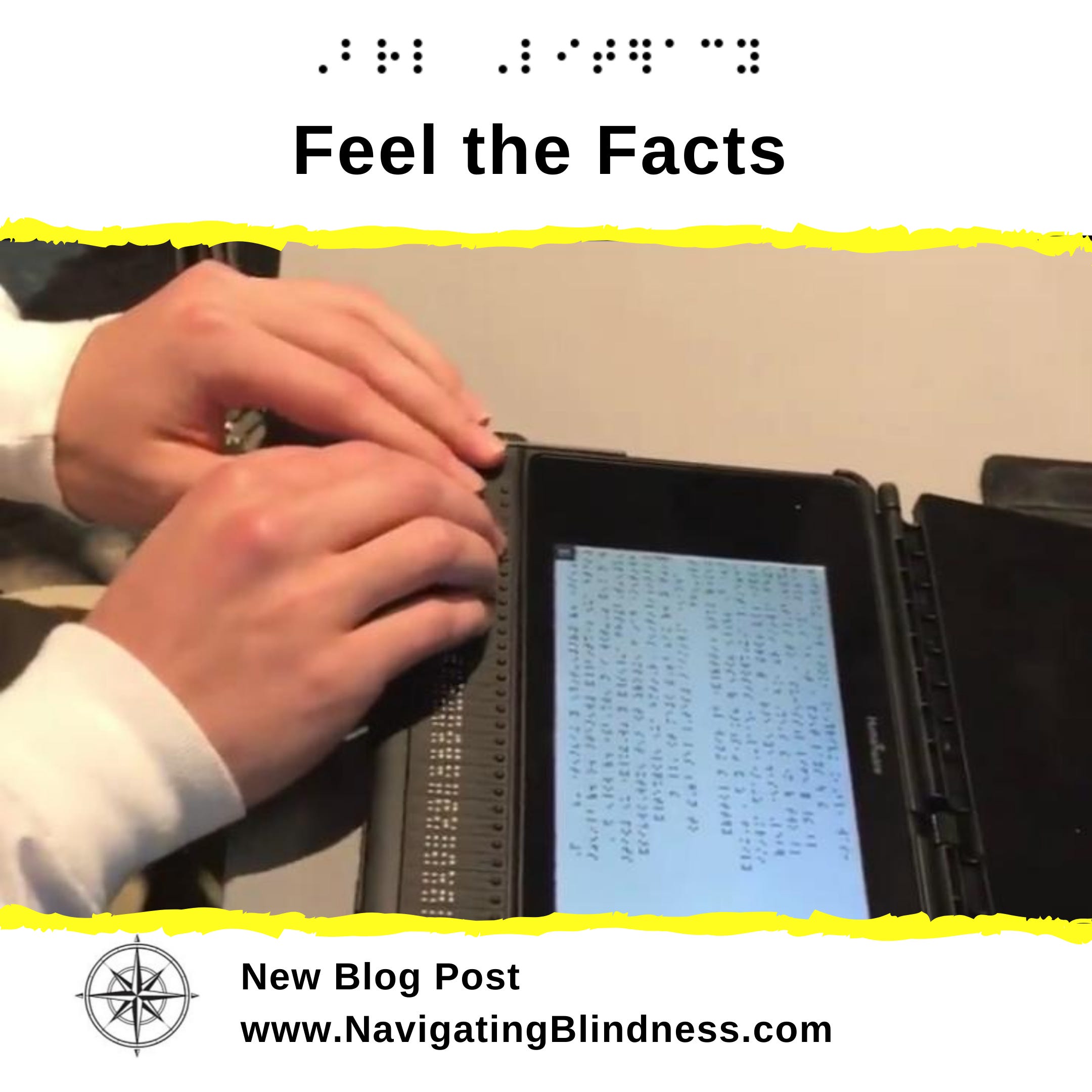
To wrap up our month of braille literacy guest blogs, I’ve asked Kai to share his thoughts about braille literacy. Kai has helped several families, with children who are losing their sight, to understand how braille is helpful & relevant in 2020. Kai is now a college-bound senior in a mainstream, public high school and he is at the top of his class. Here’s what he wants you to know about braille.
Feel the Facts by Kai Owens
30% of all blind people are employed, which means 70% are not. 90% of the employed are braille readers. This means that if you do not read braille then there is only a 3% chance that you will be employed in your lifetime. THREE PERCENT!
So, for every 100 blind people who do not read braille there will be only 3 who are employed.
Many parents argue that auditory versions of assistive technology are sufficient for their child, but the statistics and my own personal experience prove otherwise. The use of Braille makes many tasks tremendously easier. Imagine giving a long speech or presentation and needing notes or a script. It is extremely difficult to recite parts of a script well and sound educated if you are trying to listen to the words in an earbud as you are presenting. Another scenario is when completing math or science courses. Understanding complex math or science is nearly impossible auditorily. I have found it basically incomprehensible after the lessons get to a certain level of difficulty. Also, you are technically considered illiterate if you cannot read print or braille at a certain proficiency. It’s very difficult to understand sentence structure, punctuation, and spelling without braille.
Why would any parent support the idea that being illiterate is OK and will serve their child well in life? Please give your child the absolute best odds for success. There is no downside to learning braille.
Facts (source: Brailleworks.com)
60% of students who are blind drop out of school.
70% of adults who are blind are unemployed.
90% of employed persons with vision impairments can read and write braille.
A few words from Kim (mom):
When Kai began to lose sight at the age of 10 we did our research and realized that braille was essential for education and employment.
Kai had an IEP and was taught braille one period per day in the early years. He also studied braille in summer school. Sometimes he didn’t want to, but he was 10-13 and we simply insisted and explained the importance. He was a trooper but there were tears shed on both sides.
If you find that your school does not support braille, push them. The law requires that braille be taught (unless there are other factors that keep your child from being able to tactilely access the content.) It’s worth fighting for! For more information, please reference our experience filing a formal complaint and mediation against our school district. We’re here to help if you need support.
You are never too old to learn braille. I am 51 and I am becoming a certified braille transcriber through the NFB/Library of Congress. I want to be part of the long term solution. There is also a great course offered to parents through Hadley.
Parents, please do your research and talk to successful adults who are blind and employed. In our experiences, we always hear that braille is essential. And, if someone happens to be employed and doesn’t know braille they always tell us that they wish they had learned. As Kai says, there is no downside to learning.