

The first time I turned the ignition of my used, greenish-orangish, Toyota Celica, a wave of relief washed over me – FREEDOM! My Prince cassette tape blasted on repeat as the cool Portland air whooshed in through the windows. That vehicle, that my friends dubbed “Gr-orange,” delivered many coming-of-age adventures.
So, when a retinal specialist said that our ten-year-old son was “going blind,” one of the first questions we asked was, “Will he be able to drive?”
“No,” he’d responded. “He’s already legally blind and will continue to lose sight.”
For a few years post-diagnosis, our lives ground to a halt as we figured out how to navigate life again. But as Kai’s 16th birthday approached, he had more than five years of orientation and mobility (O&M) training and we’d all returned to life at full speed. A fast walker with a white cane, Kai stayed active. He’d even found adaptations that allowed him to skim board, surf, and skateboard with his friends – but driving was out of the question.
But the questions still came. As his classmates reached this milestone birthday, driving was a major topic of conversation. Kai’s friends would ask, “When are you getting your license?”
He’d laugh it off saying, “Think about that for a moment.”
After an awkward silence, his friends typically replied with something like, “Duh, I’m sorry” or “Ah, man, I forgot that you can’t drive.”
I’d never known anyone who was blind, so I couldn’t foresee all the challenges we’d face, but his 16th birthday stood out from the beginning as something that would be a huge hurdle. As the big day approached, the sensation of loss rolled back into our lives. Our town in rural Georgia lacked public transportation so not having wheels was a true access issue. The feelings of anger and injustice crashed into Kai, hard. We listened as he wrestled with his reality and we provided comfort when his tears spilled over. We had several emotion-filled discussions and we did our best not to problem solve, understanding that there were solutions, but Kai’s grief needed space and a voice. We needed to allow him to fully express himself, without placing an added burden of brainstorming solutions, hearing platitudes, or considering silver-linings.
For more on this topic click here to read about the Ring Theory for supporting people in crisis: comfort in, dump out.
After the intensity of his feelings subsided, I initiated discussions about rideshares and mass-transit systems like the Metro we’d rode in DC and the MAX in Portland. We gave him a flexible curfew so that he could go out with his friends and return home based on the driver’s schedule. And our older son, Cash, offered Kai rides so he could venture out parent-free. Yes, there were options, but there was also grief. (At that time rideshares did not allow anyone under 18 to book a ride without an adult present.)
Later, we went to the Department of Motor Vehicles and applied for his State ID. It was a trend for new drivers to post a picture on social media holding their licenses in front of the DMV sign. As a joke, Kai decided to post a picture of him holding his white cane and his new State ID in front of the sign.
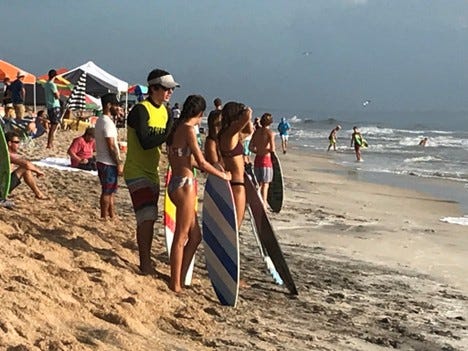
Sixteen didn’t mean driving, but it became a grand celebration of independence. We gave Kai a fully-accessible, tactile Bradley watch. And held his weekend-long birthday party at his favorite place, the beach. He and his friends skimmed and surfed the hours away then relaxed in the pool after dark. We ate cupcakes and pizza, and laughed. There was so much laughter.
At one point, he and his friends met some girls, and he pulled me aside to say, “Please video a few of our skims, but make yourself scarce...” I felt relieved realizing that we’d made it past this major milestone, and how even without access to a car, he had become a typical 16-year-old – snark and all.